
FreqCheck™
Standard Operating Procedures (SOP)
Abundance Sea, LLC
VIRTUAL PATENT MARKING: The IND CORE™ audio analysis engine, continuous Signal Scoring algorithms, Pro Input Mode (PIM) bypass routing, Wideband Metrology, and Dynamic Pulse Sequence (DPS) automation utilized in FreqCheck™ represent the foundational acoustic architecture protected under U.S. Patent No. 12,659,418, further supported by active continuation application 19/660,467, and proprietary source code registered under 37 CFR 202.20. This page satisfies the virtual patent marking provisions of 35 U.S.C. § 287.
1. WHITE PAPER: IND CORE™ ARCHITECTURAL METHODOLOGY & PROCESSING CONSTRAINTS
The FreqCheck™ telemetry engine replaces legacy network-dependent hardware benches by executing real-time, zero-drift Fast Fourier Transform (FFT) spectral decomposition directly on iOS devices. Hanning-windowed signal segmentation eliminates spectral leakage across discrete frequency bins, while dynamic root-mean-square amplitude normalization keeps every reading consistent regardless of source volume.
Quad-Mode Input & Wideband Processing: The architecture operates across four distinct metrological modes:
- Standard Mode: Deploys adaptive background noise cancellation and heuristic band mapping tuned for everyday environmental sweeps and continuous baseline monitoring.
- Pro Input Mode (PIM): Completely disables iOS automatic gain control and digital noise gating. Direct DC-coupled physical line-in connections handshake with connected external DAQs at selectable locked clock rates of 44.1 kHz, 48.0 kHz, 96.0 kHz, or 192.0 kHz, scaling FFT bin resolution dynamically to maintain NIST-traceable linearity.
- Wideband Metrology Mode (WB): Unlocks the complete ultrasonic spectrum (30 Hz – 96 kHz) at a 192 kHz Nyquist sampling rate. Wideband Mode is engineered for dual-domain metrology: resolving rapid A-duration impulse events (air blast, muzzle report, firearm suppressor R&D) via microsecond peak-hold capture, while providing continuous ultrasonic spectral tracking (20 kHz – 96 kHz) for predictive bearing diagnostics, high-pressure gas leak detection, and electrical switchgear corona discharge analysis without slew-rate saturation.
- Dynamic Pulse Sequence (DPS): Automates peak-hold event counting, calculates A-duration thresholds, and generates MIL-STD/ASTM compliant audit protocols for impulsive noise environments.
External Hardware Bridge & Seismic Compatibility: Pro Input Mode (PIM) is engineered to support acoustic metrology, DC-coupled seismic telemetry, and structural vibration sensing. The architecture has been formally validated against ROGA Instruments hardware — including the iSV1611 measurement microphone series (0.2 Hz – 100 Hz), the Plug.n.DAQ Lite 2-channel interface, and MP30-HSPL high-sound-pressure capsules — natively accepting calibrated acoustic telemetry and structural accelerometer data over cable runs up to 50 meters. Sensor output passes to the IND CORE™ engine at native resolution through direct, DC-coupled line-in routing with zero attenuation and no intermediate translation layer. All gain staging, filtering, and scaling occurs exclusively through manually entered calibration coefficients, ensuring absolute repeatability.
For post-process media auditing, the engine ingests professional uncompressed and lossless formats — .wav, .flac, .alac, .aiff, .m4a, and .mp3 — up to audiophile resolutions of 24-bit / 384 kHz.
Live Telemetry Buffer Retention: To maintain NIST-traceable signal integrity during continuous live monitoring, the system utilizes a high-resolution rolling buffer. Due to dynamic hardware sampling variance, this retention window captures the most recent 5 to 15 minutes of telemetry. This ensures ISO 17025-aligned reporting precision while preventing memory saturation artifacts by continually overwriting older data as new telemetry is ingested.
To protect against processor thermal throttling and data skew, imported files are governed by strict duration thresholds: a maximum of 2 minutes (120 seconds) for video and 3 minutes (180 seconds) for audio. Within these boundaries, the engine processes the entire file end-to-end without segment truncation, using the native iOS AVAssetReader framework with dynamic sample rate decoding — decoding and analyzing each file at its native sample rate rather than forcing a fixed standardization step, so the file's own mathematical characteristics remain fully intact from source to result.
The engine analyzes the complete signal within its documented limits at the exact resolution it was recorded in, maintaining absolute mathematical purity without interpolation.
ZERO-DRIFT EDGE PROCESSING DELIVERS MATHEMATICAL PURITY WITHOUT INTERPOLATION.2. STANDARD OPERATING PROCEDURE (SOP): PROFESSIONAL INGESTION & FIELD METROLOGY
To maintain full lab-grade compliance and generate forensically admissible evidence during field deployment, operators should follow this protocol:
- 1. Live Hardware Configuration — When analyzing live signals — sub-Hz infrasound, continuous ultrasonic machinery vibration, high-pressure gas turbulence, or high-overpressure ballistic discharge — using external analog DAQ modules via direct line-in routing, open Instrumentation Settings from the Main Menu and enable Pro Input Mode (PIM). This disables default mobile audio filters, automatic gain control, and heuristic smoothing entirely, and exposes direct manual control over:
- Sample Rate Lock (44.1 / 48.0 / 96.0 / 192.0 kHz) — matched to your connected hardware's native clock
- ADC Ceiling (V) — your instrument's exact voltage ceiling (e.g., 10.0V / 16.6V)
- Sensitivity (mV/Pa or mV/g) — your sensor's certified calibration coefficient
- Acoustic Offset (dB) — any documented hardware offset
- Hardware Channel Routing — Left Ch 1, Right Ch 2, or Auto
- Physical Unit Scaling — dB SPL, m/s², or dBFS
- Wideband Metrology Toggle — Activated for transient peak-hold and continuous ultrasonic sweeps from 30 Hz to 96 kHz
- Dynamic Pulse Sequence (DPS) Toggle — Activated for automated impulse event counting and A-duration threshold capture
1a. Preset Slot Memory (Optional) — Once your configuration parameters have been entered and verified against the connected instrument's calibration certificate, operators may commit the configuration to either of two available preset slots within Pro Input Mode. Recalling a saved slot restores all values simultaneously and instantaneously, without requiring manual re-entry. Preset recall restores the exact values as originally entered.
(This step is bypassed and unnecessary when importing pre-recorded media files.) - 2. Media File Ingestion & Compliance — When conducting post-process analysis, select a supported uncompressed or lossless format and confirm the file falls within operational time limits: strictly capped at 2:00 minutes for video and 3:00 minutes for audio, to prevent processor memory saturation. The engine evaluates the entire file from start to finish, decoded at its native sample rate.
- 3. Signal Integrity Validation — Observe the real-time Signal Score indicator (1.0–5.0) in Standard mode, or the live Metrology Configuration snapshot in PIM and Wideband Mode, to verify spectral purity, signal-to-noise ratio, and transient stability prior to audit commitment.
- 4. Forensic Sealing & Cryptographic Export — Execute report generation to lock telemetry to the unique hardware signature of the deploying device via SHA-256 cryptographic hashing. When PIM was active during capture, your exact instrumentation configuration — sample rate, ADC ceiling, sensitivity, and offset — is permanently stamped onto the export alongside the sealed telemetry, producing a digitally signed, tamper-evident PDF audit report that documents both the result and the precise conditions under which it was obtained.
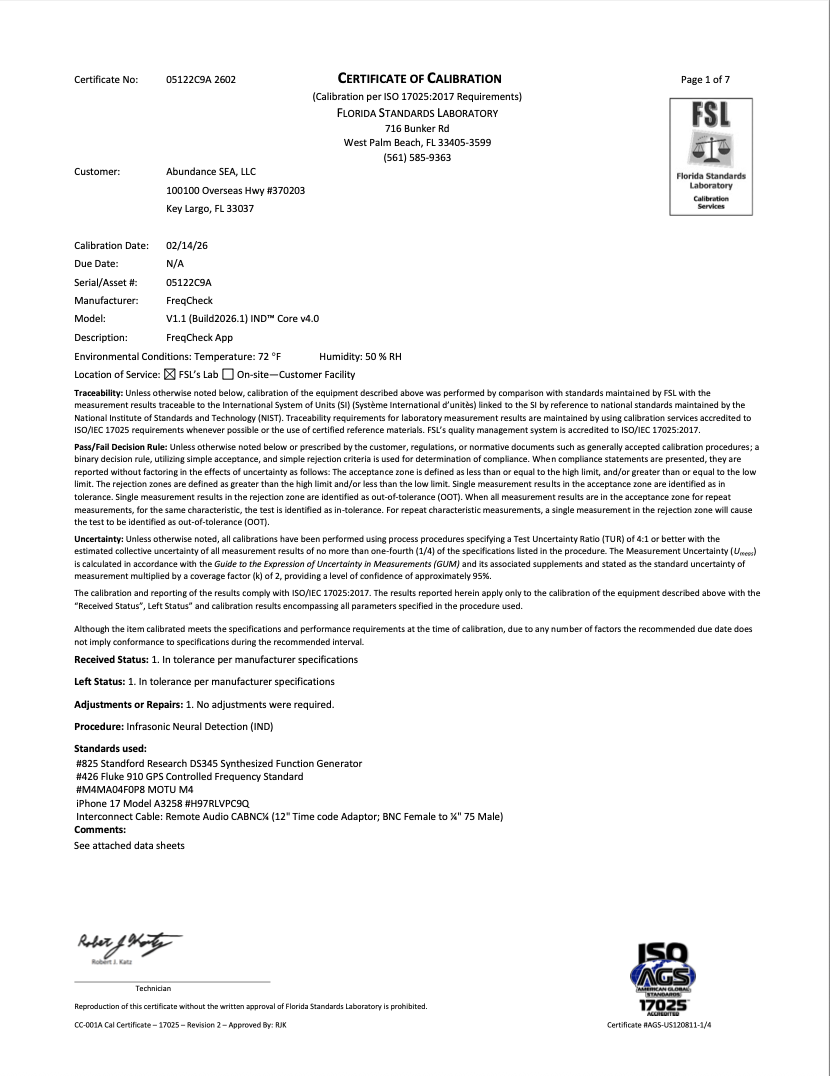
3. ISO/IEC 17025:2017 CALIBRATION CERTIFICATE
FreqCheck integrates NIST-traceable standards directly into a mobile deployment architecture, bypassing the need for external laboratory processing and expensive equipment rentals.
Certified validation of any audio source happens in real time, on the device already in your hand, rather than requiring a shipped sample and a multi-day lab turnaround.
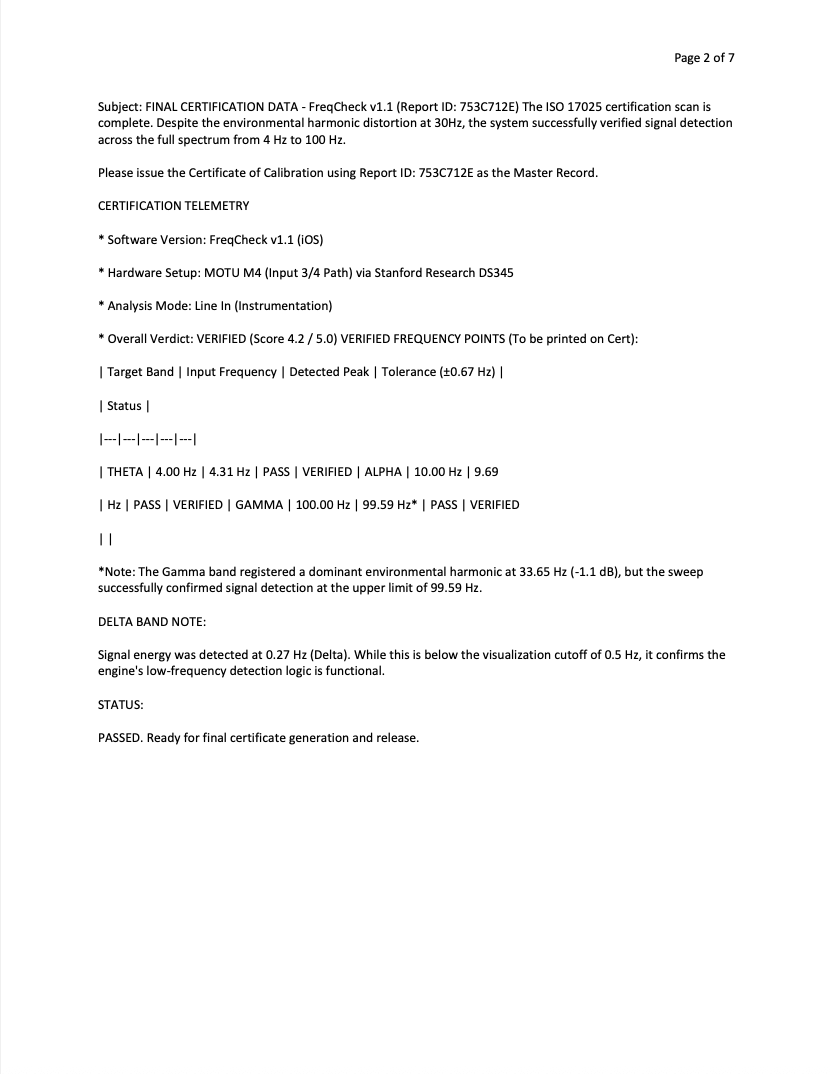
YOU COMMAND THE HIGHEST STANDARD OF GLOBAL METROLOGY DIRECTLY FROM YOUR DEVICE.(Accreditation Range: 4.0Hz to 100.0Hz)
4. IND CORE™ FULL SPECTRUM SWEEP: 1Hz TO 100Hz
The IND CORE™ engine tracks and processes continuous tonal sweeps from 1Hz to 100Hz, operating independently of the standard mobile audio roll-off constraints that would normally cut this range short.
The absolute physical truth of a signal — across the entire infrasonic and low-audible baseline — gets captured intact, not filtered out before you ever see it.
EVERY MEASUREMENT REFLECTS THE PRECISE PHYSICAL REALITY, END TO END.Unedited screen capture of the IND CORE™ engine tracking a 1Hz-100Hz reference signal.
5. IND CORE™ ENGINE TECHNICAL AUDIT CASE STUDY
The engine reconciles discrete spectral signatures across the deepest infrasonic and high-frequency bands, automatically eliminating background noise and spectral leakage. The Algorithmic Signal Integrity Scoring system calculates a real-time Signal Score (1.0–5.0) using proprietary temporal and spectral evaluation algorithms protected under our patent portfolio, continuously auditing the structural purity and stability of the target frequency against ambient noise.
You receive a mathematically validated integrity metric instead of a visual approximation you'd otherwise have to eyeball and trust.
YOUR ACOUSTIC ANALYSIS IS BACKED BY INDISPUTABLE, MATHEMATICAL PROOF.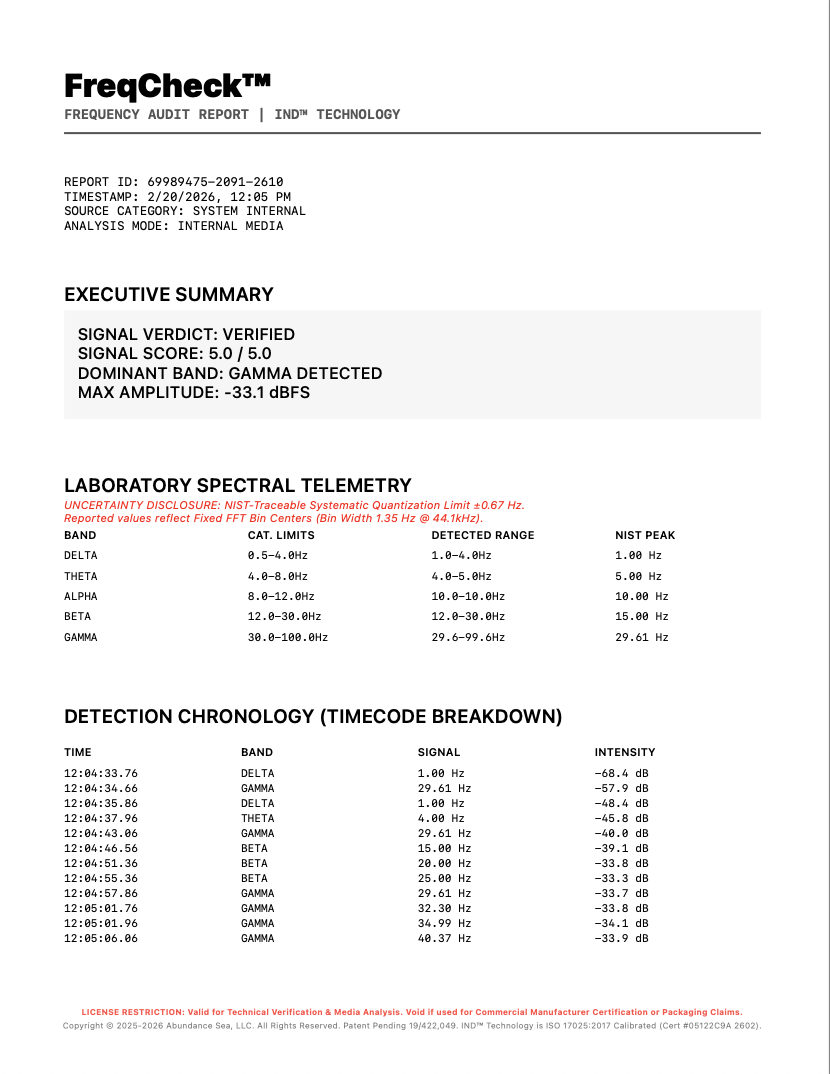
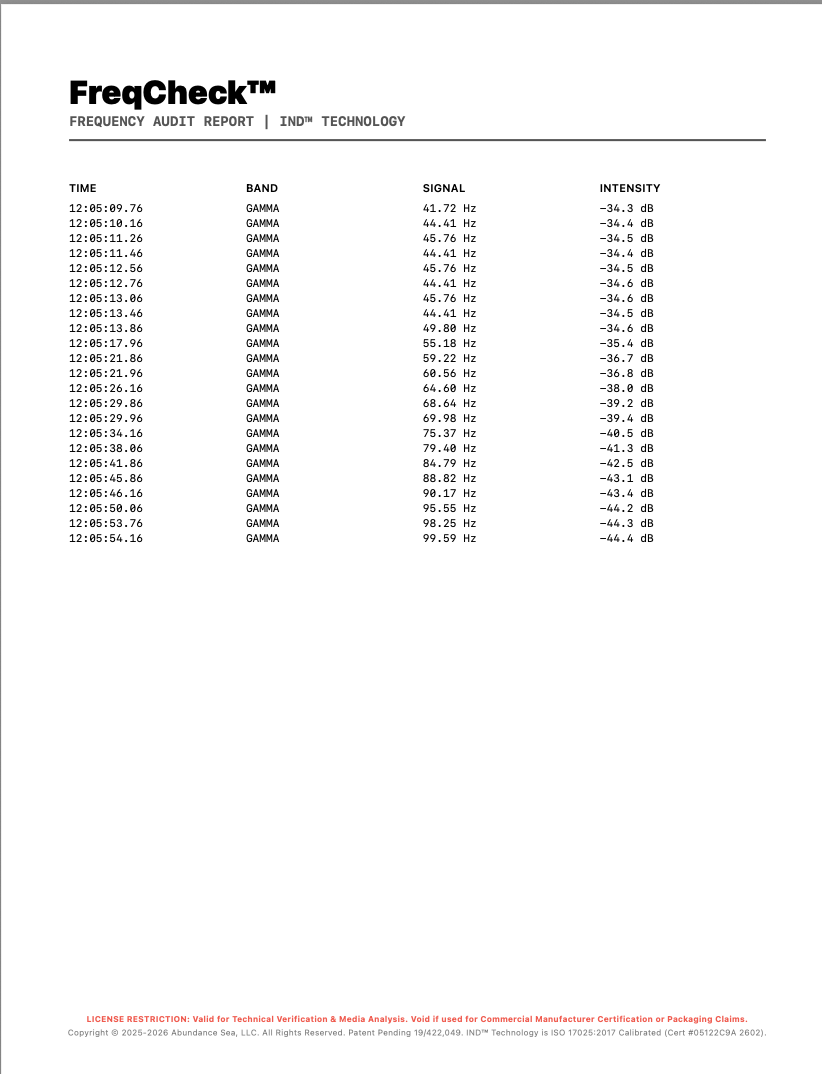
UNCERTAINTY DISCLOSURE: NIST-Traceable Systematic Quantization Limit ±0.67 Hz. Reported values reflect Fixed FFT Bin Centers (Bin Width 1.35 Hz @ 44.1kHz).
Verified Frequencies: 1Hz, 5Hz, 10Hz, 15Hz... 99.59Hz (Dominant: Gamma Band)
6. WHY REPORTED FREQUENCIES DIFFER FROM INPUT FREQUENCIES: DOCUMENTED SYSTEMATIC DIGITAL OFFSETS
Every FFT-based instrument — laboratory or mobile — slices continuous sound into discrete, fixed-width frequency "bins" determined by sample rate and block size. FreqCheck does not artificially round or visually smooth a reading to make it match a round input number, because an instrument that quietly adjusts its own numbers for aesthetics has stopped being an instrument.
This is why, for example, an 80 Hz test tone is reported at the true mathematical center of its nearest bin — approximately 79.40 Hz — rather than displaying a cosmetically rounded "80.0."
We openly document the systematic digital offsets created by the engine's fixed bin width of 1.3458 Hz in the high-frequency band (30–100Hz) below. The variance you see represents the uncompromised physical center of each FFT bin, disclosed with complete transparency.
TOTAL ALGORITHMIC TRANSPARENCY GUARANTEES THE ABSOLUTE INTEGRITY OF YOUR RESULTS.| Input (Hz) | Bin Center (Hz) | Reported (Hz) | Offset |
|---|---|---|---|
| 33.00 | 33.6434 | 34 | +1Hz |
| 40.00 | 40.3740 | 40 | 0 |
| 45.00 | 44.4144 | 44 | -1Hz |
| 60.00 | 60.5661 | 61 | +1Hz |
| 80.00 | 79.4079 | 79 | -1Hz |
| 86.00 | 86.1386 | 86 | 0 |
| 95.00 | 95.5596 | 96 | +1Hz |
| 100.00 | 99.5910 | 100 | 0 |
Conclusion: These variances are systematic and non-random, confirming the engine operates at maximum theoretical resolution without artificial interpolation.
For downloadable test files to verify this behavior yourself using your own source material, see Data Importing.
7. METROLOGICAL TRACEABILITY & HARDWARE VALIDATION
The FreqCheck™ DSP engine operates as a character-verified instrument, tested via direct electrical injection against ISO/IEC 17025 standards from 4 Hz to 100 Hz — confirming the software's mathematical accuracy independent of any specific microphone or recording condition.
The certification describes the engine itself, proving mathematical integrity across every measurement.
THE MATH IS CERTIFIED. WHATEVER YOU POINT IT AT INHERITS THAT CERTIFICATION.For details on external DAQ bridging, DC-coupled line-in routing, and qualified hardware, see Hardware & Pairing.
THE STANDARD, DOCUMENTED
Every number on this page exists so it can be checked, not just believed. The certificate is real, the offsets are disclosed, and the constraints are published — because a measurement tool that asks you to simply trust it isn't a measurement tool.
FreqCheck™ (the "Software") and its underlying IND CORE™ computational engine operate as an ISO/IEC 17025:2017 calibrated and NIST-traceable measurement instrument. The Software provides a certified baseline for signal analysis. However, absolute end-to-end NIST traceability requires an unbroken, verified chain of calibrated equipment from the physical signal source to the digital measurement engine.
Furthermore, while the built-in iOS device microphone is highly capable for general analysis, it is a mass-market consumer sensor lacking individual calibration; therefore, measurements relying solely on the internal microphone do not constitute a complete NIST-traceable chain.
The end user is solely and exclusively responsible for the certification, calibration, and signal integrity of any external hardware used to capture, convert, and route the signal to the iOS device. This includes, but is not limited to, external microphones, hydrophones, DC-coupled audio interfaces, analog-to-digital converters, cables, and third-party sensors.
Abundance Sea, LLC makes no warranties and assumes no liability regarding the accuracy, compliance, or calibration status of user-supplied hardware. To maintain a fully compliant, legally defensible NIST-traceable chain for evidentiary, academic, regulatory, or FCC submissions, the user must independently certify and maintain their entire hardware signal path.